

Shakespeare's Mothers
by Henry Oliver

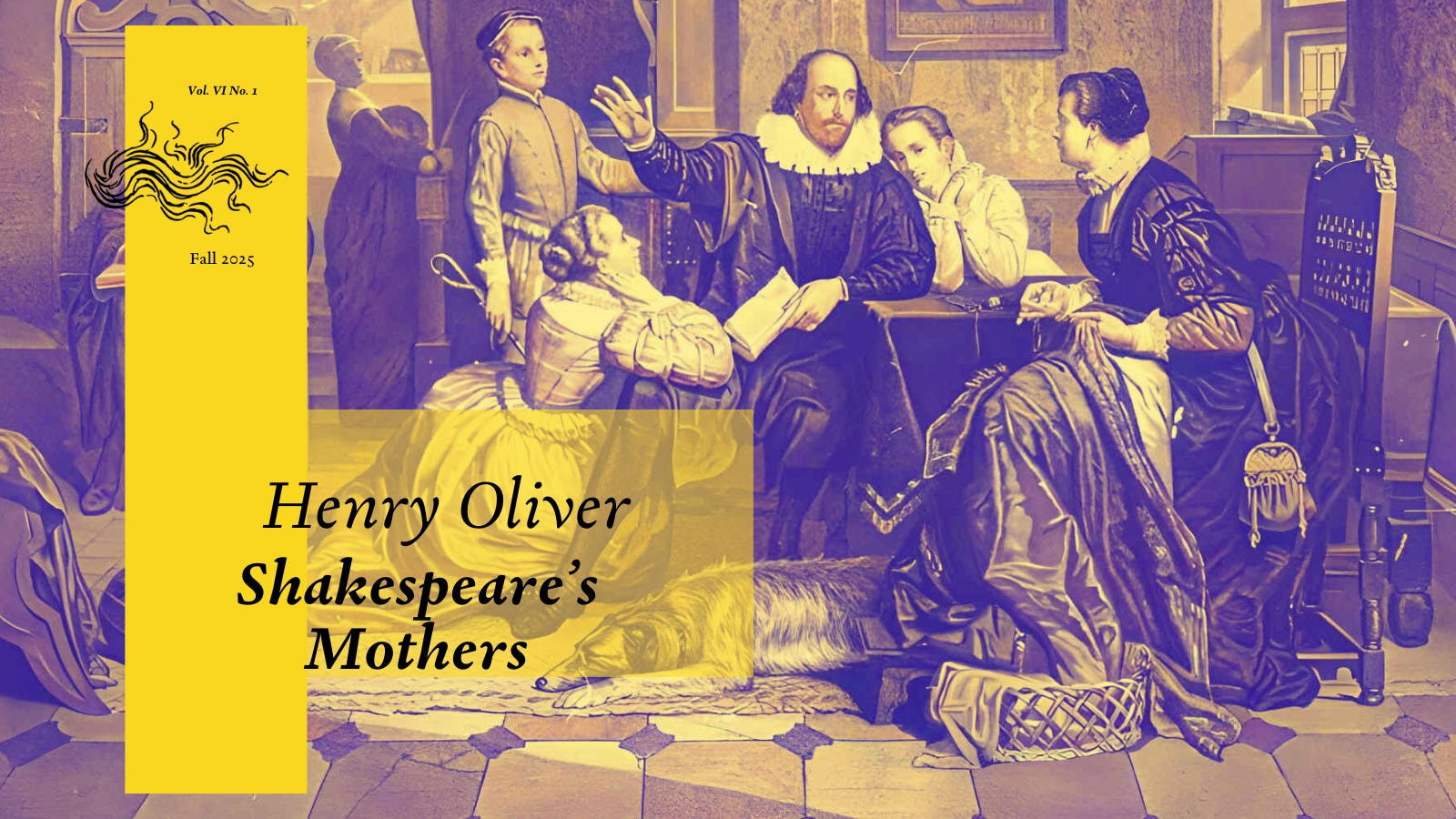
Henry Oliver is a fellow in the Emerging Scholars Program at the Mercatus Center at George Mason University. This essay, originally published in Liberties Volume 6, Number 1, focuses on the rare Shakespearean mother who is instrumental and constructive in the “unjustly unloved” All’s Well That Ends Well.
You can read more from Henry on Substack at The Common Reader and The Pursuit of Liberalism.
Shakespeare’s mothers are often nasty. Lady Capulet ignores, then disowns, poor Juliet. Lady Macbeth would kill her child to gain a throne. Though they grieve (Constance in King John) it is vicious grief (Queen Margaret in Richard III). Sometimes they are terrifying: Volumnia raised Coriolanus to be a tyrant; Tamora encourages her son to commit rape in Titus Andronicus. Often, there are no mothers. O! Cordelia, Katherine, Miranda, Jessica — think how they need their mother’s love!
Many are minor. Aemilia in A Comedy of Errors appears at the end, a resolution. The blameless Lady Macduff appears only to be hauntingly killed, a brief symbol of innocence in a darkening world. There is a wicked step-mother (Cymbeline), a jealous step-mother (Pericles), a weak-willed mother (Hamlet). It is almost incidental that Mistress Page (The Merry Wives of Windsor) is a mother; Cleopatra, too. Only Hermione’s strong innocence in A Winter’s Tale makes her rightfully beloved.
Hermione has a splendid precursor, the Countess of Rousillion, from All’s Well That Ends Well. This play is unjustly unloved, and the Countess gets less attention than she deserves. She is among Shakespeare’s most fascinating characters, and is his most wonderful mother.
All’s Well That Ends Well is an inverted romance in which the woman pursues the man. It is also about inverted families. It is often said that we cannot choose our parents: Shakespeare is interested in the fact that we cannot choose our children. Just as Helena inverts the expectations of a romantic heroine, so the Countess inverts the expectations of a mother, and picks her child.
Bertram’s father is dead. He is now a ward of the king. His mother the Countess is left in Rousillion with her own ward, Helena, a doctor’s orphan. Helena reveals to the audience that she loves Bertram and plans to go to Paris to cure the king of his fistula (using her father’s remedies) so he will marry her to Bertram. The Countess discovers this, and, knowing Bertram is a hopeless boy in whom “blood and virtue contend for empire,” promises Helena her help. The cure works! But Bertram refuses marriage because Helena is low born. The king’s pride forces the wedding. That night, Bertram absconds. Helena returns to the Countess, who is doubly distressed that Bertram has disobeyed the king and treated Helena badly. Bertram said he will have “Nothing in France” until he has no wife. So Helena, distressed that Bertram has gone to war, runs away so that he may return. Hearing that Helena has gone on pilgrimage, the Countess is heartbroken. When Helena told her Bertram absconded, the Countess replied: “I do wash his name out of my blood, / And thou art all my child.”
On her travels, Helena discovers that she is in the same town as Bertram, where he is wooing a virgin. When he left, Bertram told Helena they would be together if she got the ring from his finger and was pregnant with his child. Helena tells the virgin, Diana, and Diana’s mother, that she will provide them with a dowry if they help her. Diana bids Bertram come to her, give her his ring, and she will sleep with him. At the crucial moment, Helena takes Diana’s place (the “bed trick”). Diana also gives Bertram a ring of Helena’s, which exposes him later on at court as a liar, rogue, and cad. Then Helena returns with his ring and baby. And all’s well that ends well.
The plot comes from Boccaccio, via a translation. The Countess is Shakespeare’s. Without her, the story would play differently. Helena is not, as some have said, predatory. She is guided and approved of by the Countess. The play does not condemn her; the Countess shows us she is to be understood, not feared. Helena is one of Shakespeare’s great experiments. She inverts the expectations of her sex without losing her virtuous character nor destroying the basic plot of a romantic comedy, but with some of the most daring challenges to the form in the whole Shakespeare canon. She is matched in this by her adoptive mother.
When the countess discovers that Helena loves Bertram she has no class pride, but feels great sympathy.
Even so it was with me when I was young:
If ever we are nature’s, these are ours; this thorn
Doth to our rose of youth rightly belong
Helena appears and the Countess says “You know, Helen, / I am a mother to you.” Helena quibbles. “Mine honourable mistress.” The Countess replies, not in her usual mellifluous lines, but in broken speech.
Nay, a mother:
Why not a mother? When I said “a mother,”
Methought you saw a serpent: what’s in “mother,”
That you start at it? I say, I am your mother
Helena’s speech is characterized by caesura. She has a verse of deliberation, uncertainty, thinking. The Countess mirrors this to draw Helena out, rather than confront her. She even slips in the prospect of marriage,
Yes, Helen, you might be my daughter-in-law:
God shield you mean it not! daughter and mother
So strive upon your pulse. What, pale again?
My fear hath catch’d your fondness
As the scene reaches breaking point, Helena is overwhelmed and confesses her love on her knees, saying “My friends were poor, but honest; so’s my love”; begging the Countess, “Let not your hate encounter with my love.”
Were this a scene between father and daughter, it would turn vicious. “Out baggage!” screams Lord Capulet. Polonius demands demure obedience of Ophelia. Lear rages at Cordelia, Brabantio at Desdemona. Not the Countess. She tests Helena’s plan to cure the king (“how shall they credit / A poor unlearned virgin”) and, satisfied of her mettle, tells her:
Be gone to-morrow; and be sure of this,
What I can help thee to thou shalt not miss.
It is a very fine moment. The Countess knows Bertram lacks the sense and virtue Helena exemplifies. She tried to advise him when he left for court, but added to his mentor: “’Tis an unseason’d courtier; good my lord, / Advise him.” Alas, Bertram is lost to the maleness of court and the banter and bawdy of Parolles, a braggart who leads Bertram wrong.
The Countess knows Bertram is lost. But she can mother Helena, a girl much in need of a parent. Together they are the opposite of the rash and manly court: calm, discursive, supportive, clever.
The Countess is more able to govern her emotions than her impetuous son and his anger-prone king. She unsexes herself like Lady Macbeth, but in a pragmatic, not bloody manner. On hearing of Bertram’s departure for war, she says,
Pray you, gentlemen,
I have felt so many quirks of joy and grief,
That the first face of neither, on the start,
Can woman me unto’t
We will not catch her shedding woman’s tears, as her sex and genre have primed us to expect. She knows Bertram is too proud of his heritage (she says his behaviour “corrupts a well-derived nature”) and urges him “succeed thy father / In manners, as in shape.” Helena, by contrast, has raised herself up in virtues “her education promises; her dispositions she inherits, which makes fair gifts fairer.” The Countess cannot change them. But she can change who and how she mothers.
As Bernard Shaw said, the Countess is “the most beautiful old woman’s part ever written . . . full of wonderfully pleasant good sense, humanity, and originality.” Who else in Shakespeare sees their own hapless children so free from illusion and gives their “maternal tenderness and wisdom” to an orphan who needs her most? The Countess is a pragmatist, but not cold-hearted; a realist, but not venal.
The play does not end at court, where the marriage was enforced. It closes in Rousillion, where the ineffective king is the Countess’ guest. She had the opening line (setting the theme of new life from trauma: “In delivering my son from me, I bury a second husband”) and she voices some powerful declarations at the end, announcing that the rings expose Bertram as a cad. She loves her son. She pleads for him to the king. But she knows what he has done to Helena (and how little he cares for his own mother’s feelings) and she does what she can to put it right. One of the most moving moments of the play occurs at the end when Helena returns and says “O my dear mother, do I see you living?”
Shakespeare added the Countess to show us that the world is not a game of ideals. It is a contingent place, where we must do what we can to get as good an outcome as possible. Bertram believes in his class (Shaw called him a Junker with no quality other than his class quality). Helena and the Countess believe in virtue, skill, intelligence, independence.
Why should they be told what to do by these martial men? Why should they cry women’s tears? Why should Helena wait to be chosen as a wife? Why shouldn’t the Countess mother the one who loves and needs — the one who listens?
Originally published in Liberties Volume 6, Number 1. Subscribe to the quarterly journal here to receive the next four issues in print.

 | A guest post by
|